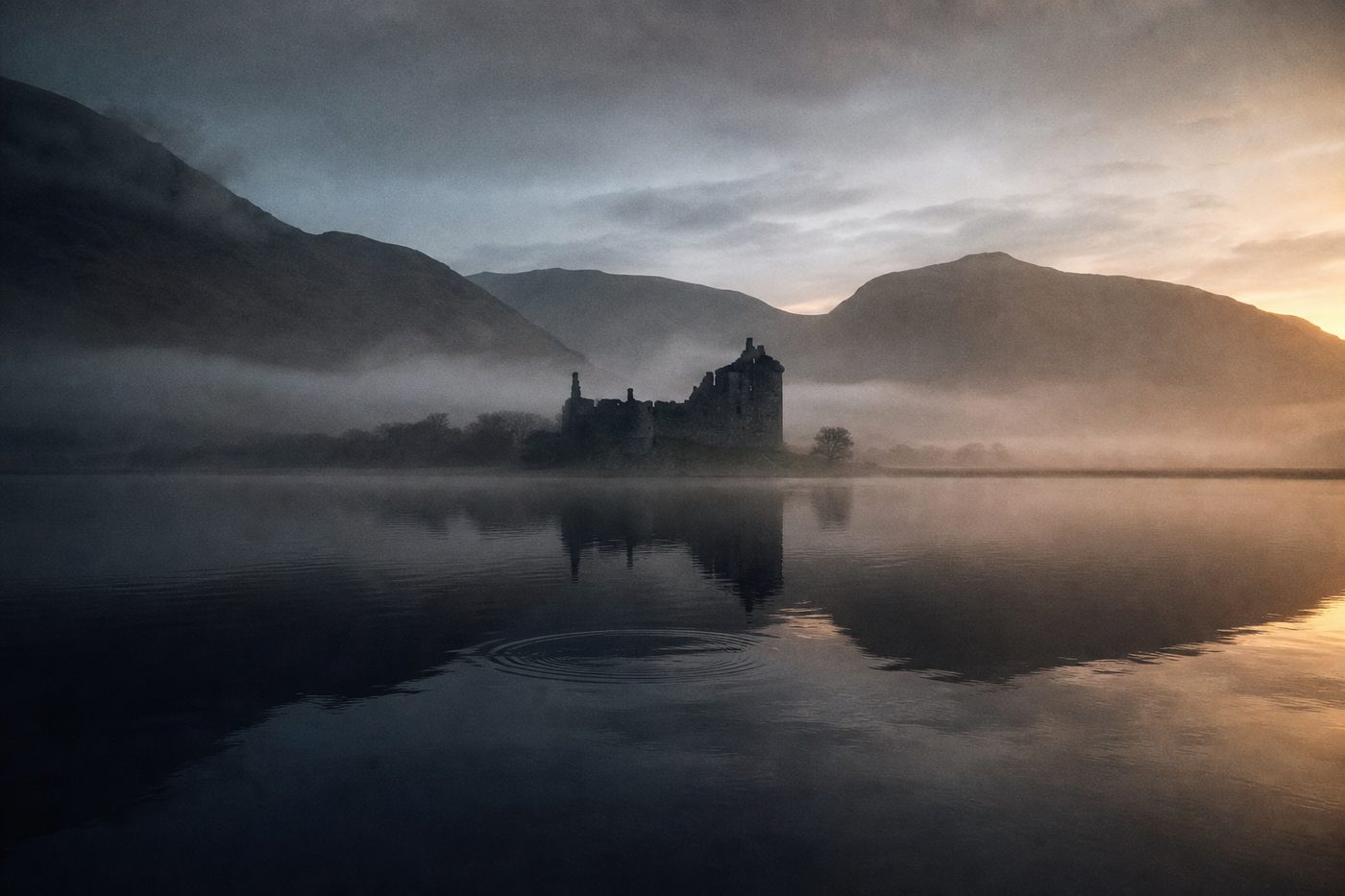
There is a particular silence to a Highland loch at first light. The water lies flat as poured pewter, the far shore dissolves into mist, and for a moment it is genuinely difficult to tell where the surface ends and the sky begins. Stand there long enough and you begin to understand, without anyone explaining it, why people once believed something lived underneath — and why they told their children to keep their distance.
That something was the kelpie: a water horse said to haunt the lochs and rivers of Scotland, appearing as a handsome, docile pony on the bank. The trap was simple and terrible. A child climbs onto its back for a ride; the skin turns adhesive; the horse plunges into the deepest water and is never seen again, save perhaps for a heart or a liver washed ashore the next morning. It is one of the bleakest creatures in the British folk canon — and one of the most misunderstood.
Today the kelpie is mostly a brand. Two thirty-metre steel sculptures rear over a canal basin near Falkirk; the name sells whisky, festivals and soft toys. But peel back the merchandise and you find something older and stranger: a story that did real work in real communities, for reasons that have almost nothing to do with the supernatural.
What the Earliest Tellings Actually Say
The word kelpie first appears in print in the late eighteenth century, but the creature it names is much older, and it never had a single fixed shape. In some districts it was a horse; in others, a rough-haired man who lurked by the ford; on the Hebridean islands the related each-uisge, the sea-horse, was considered far more dangerous, because it haunted lochs and the sea rather than running water, and running water — as a great deal of folklore insists — is where a person might still be safe.
The collectors who wrote these tales down in the nineteenth century, men like John Gregorson Campbell, were often ministers, and they recorded the stories with a mixture of scholarship and unease. What comes through their accounts is not a single monster but a cluster of warnings attached to specific, named bodies of water. The kelpie was always somewhere: this pool, that bend in the river, the loch below the shieling. It was local before it was anything else.
In several Highland versions, the kelpie can be tamed if a person manages to slip a bridle stamped with the sign of the cross over its head — at which point it becomes an unnaturally strong work horse. The motif of the bridle hints at how the story absorbed Christian symbolism over centuries without ever quite shedding its older, pre-Christian skin.
The Sensible Fear Underneath the Story
Here is the part the postcards leave out. Pre-modern Scotland was a country of cold, fast, deceptively deep water, and of children who worked outdoors from the moment they could walk. Peat-stained lochs hide their depth completely; a calm surface can sit above a sudden drop and a current that will pull a small body down in seconds. Drowning was not a rare tragedy. It was a constant, statistically reliable threat.
Read in that light, the kelpie stops being a piece of whimsy and becomes something closer to a public safety campaign carried by oral tradition. A warning sign requires literacy and a signpost. A story requires neither. It travels on a grandmother's voice, attaches itself to the exact pool where the danger is worst, and gives a frightening abstraction — that water can kill you — a face, a pair of soft eyes, and a horrible mouth.
The supernatural creature is often the most efficient packaging a community ever found for a piece of hard-won, life-or-death knowledge. — a principle that recurs across water-spirit folklore worldwide
This is not a uniquely Scottish insight. The Slavic vodyanoy, the Germanic nixie, the Japanese kappa who drags swimmers under — cultures separated by entire continents independently populated their dangerous waters with grabbing, luring spirits. The convergence is the tell. When unrelated peoples arrive at the same image, they are usually responding to the same underlying fact. Deep water is dangerous, children are curious, and a vivid story outlasts a hundred forgotten instructions.
How a Warning Became a Mascot
So how did a creature designed to terrify become a beloved national symbol? The short answer is that the danger receded. As Scotland drained, fenced, bridged and supervised its waters, the kelpie lost its job. A story that no longer needs to keep anyone alive is free to become entertainment — and from there, decoration.
The transformation accelerated in the twentieth century, when folklore became heritage. The kelpie's menace was sanded down into mystery; its specific lochs blurred into a generic "Scotland"; and the creature joined the tartan, the thistle and the Loch Ness Monster in the export catalogue of national identity. None of this is a betrayal, exactly. Living traditions change or they die. But something is worth holding onto in the older version — the recognition that the story was once true in the only way that matters, which is that believing it kept people away from water that would have killed them.
The kelpie and the Loch Ness Monster are frequently lumped together, but they are different orders of belief. The kelpie is a moral and protective folk creature with centuries of recorded tradition behind it. "Nessie," as a sustained phenomenon, dates only from the 1930s and grew up alongside roads, cameras and tourism. One is folklore; the other is closer to modern legend. Telling them apart is part of reading the landscape honestly.
How to Track the Kelpie Today
If you want to meet the story on its own ground, the Falkirk sculptures are the obvious starting point — vast, beautiful and unmissable. But the kelpie was never really about the spectacular. To feel the original charge, go instead to a small, dark, unmarked loch in the west Highlands at dawn, when the mist is still on the water and there is no one else around. Read the older tales the night before. Then stand on the bank and notice how quickly the rational part of your mind goes quiet.
That uneasy stillness is the artefact. It is what the story was built to produce, and it has survived every steel sculpture and souvenir shop. The kelpie endures not because anyone still believes a horse will eat them, but because the feeling the legend encodes — that the natural world is beautiful, indifferent and entirely capable of taking you — happens to be completely accurate.
And that, in the end, is why these stories last. They are not lies told to frighten children. They are truths too important to forget, dressed up well enough that we never could.
Sources & Further Reading
- Campbell, John Gregorson. Superstitions of the Highlands and Islands of Scotland (1900) — primary nineteenth-century collection of water-horse traditions.
- Briggs, Katharine. A Dictionary of Fairies (1976) — comparative entries on the kelpie, each-uisge and related water spirits.
- Scottish folklore archives held by the School of Scottish Studies, University of Edinburgh — recorded oral testimony on local loch beliefs.
- Comparative water-spirit scholarship on the vodyanoy, nixie and kappa, drawn from standard folklore reference works.

Helena Voss
Helena holds a doctorate in folklore studies and spent a decade in archival fieldwork across Northern Europe before joining Spirit Tracker. She writes about how communities encode knowledge, fear and memory into the stories they tell about place.