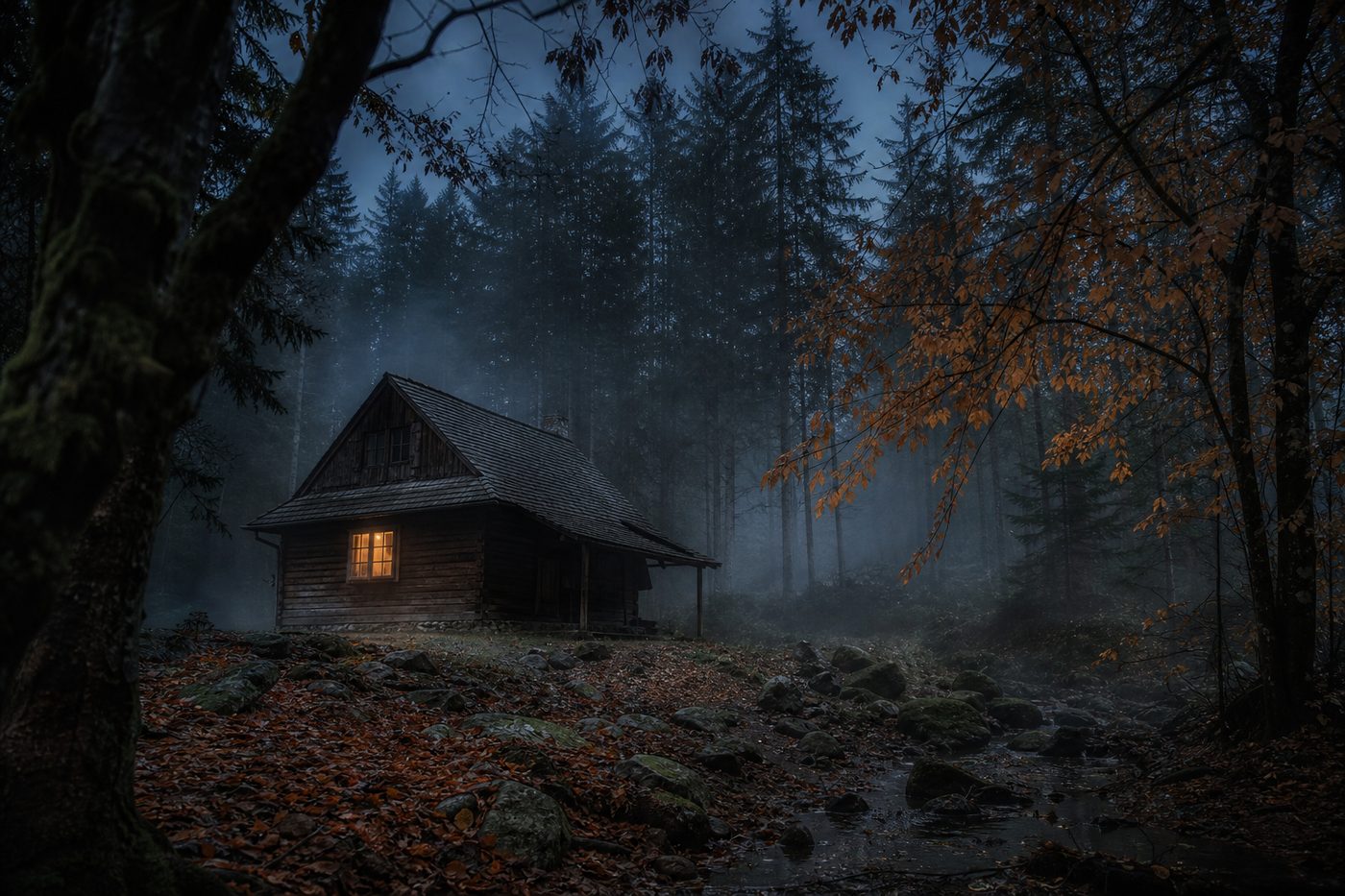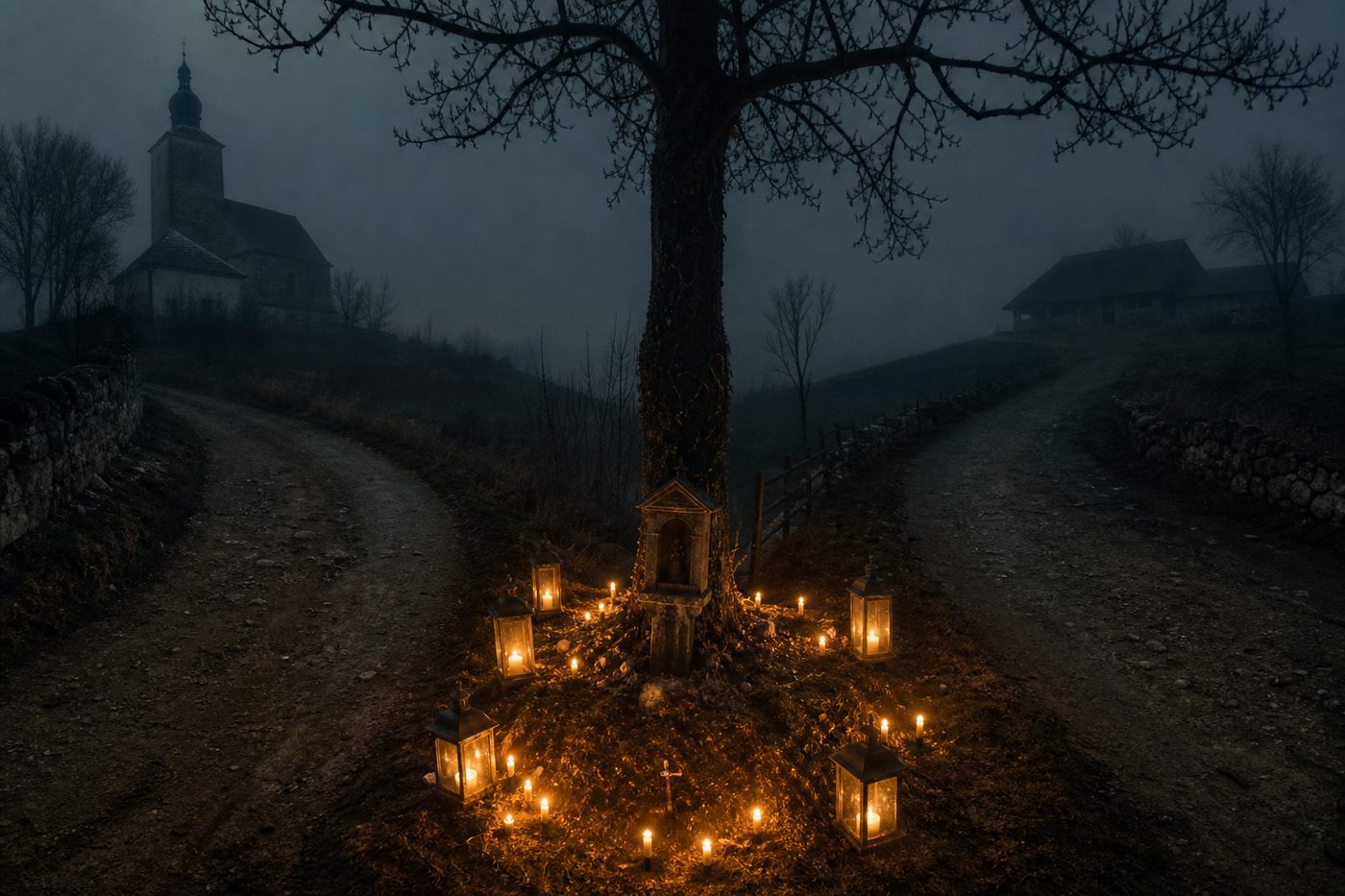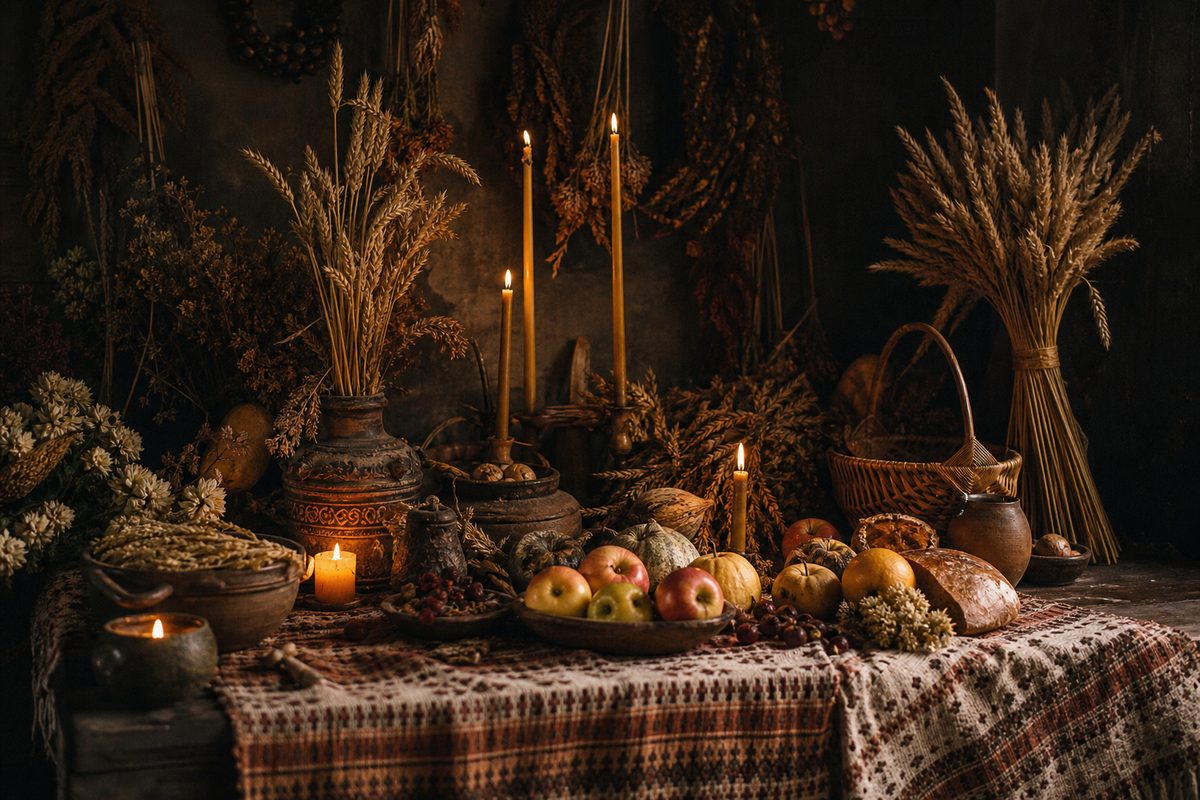
Picture the end of a long harvest day in some European field a few centuries ago. Most of the grain is in. What remains is a single ragged stand of stalks, left deliberately uncut while the rest of the field lies shorn around it. The reapers do not simply walk over and cut it. They gather, they lower their voices, and what happens next is governed by rules nobody wrote down — because everyone already knew them.
The last sheaf was not ordinary grain. From Scotland to the Slavic east, from Brittany to the Rhine, harvesters across Europe treated the final stand of a field as something charged, dangerous and worth handling with care. The customs varied enormously in their detail and almost not at all in their underlying logic. Cut this wrong, the belief ran, and you cut something more than wheat.
That something was usually called the spirit of the corn — "corn" here in the old British sense of grain in general, whether wheat, barley, oats or rye. As the harvest advanced and the field shrank, the spirit was thought to retreat before the sickles, driven back row by row until it had nowhere left to go but the last few stalks. To take that final cut was to confront it directly.
The Spirit That Fled Into the Stalks
The idea has a strange internal consistency. If the vital force of the field's fertility lived in the growing grain, then reaping was, in a sense, killing it. Most of that killing was diffuse, spread across acres and hours. But the last sheaf concentrated it. Whatever remained of the corn spirit was cornered there, in plain sight, and someone would have to strike the blow.
Communities responded to this in remarkably similar ways. In parts of Scotland and northern England the cut bundle became the focus of a small ceremony; in Germany it was sometimes called the Roggenwolf or rye-wolf, imagined as an animal hiding in the standing crop. In other regions the figure was an old woman, the Carlin or the Hag — the spent, exhausted spirit of a field that had given everything it had. The grain was both food and a body, and the last of it had to be dealt with properly.
In many districts the very name given to the last sheaf depended on timing. A farmer who finished early might cut a youthful "Maiden," full of next year's promise; the farmer who finished last in the parish was stuck with the "Cailleach" or "Old Wife" — the haggard spirit driven off everyone else's land and onto his. Being last to harvest carried a social sting that lasted all winter.
Crying the Neck, and Throwing the Sickle
Some of the most vivid records come from the West Country of England, where the ritual was called "crying the neck." When the reapers reached the last handful of stalks — the "neck" — one man held it up high while the others removed their hats and called out together, drawing the words long and loud across the field: We have her! We have her! A second group would answer from a distance, and the cry would pass from farm to farm in the dusk, an audible map of who had finished and who had not.
The "neck" itself was then plaited and carried home in triumph, often kept above the hearth or the farmhouse door until the following year. Elsewhere the same impulse produced the harvest "mare" or the "hare," a knotted bundle that the last farmer to finish might find tossed contemptuously into his unharvested field by a neighbour who had beaten him to it.
And then there is the most telling practice of all. In a number of regions the reapers did not simply cut the last sheaf — they stood back and threw their sickles at it. Each man hurled his blade from a distance, and the standing grain was felled by a volley rather than a single hand.
No one could say whose stroke had killed the corn spirit, and so no one bore the blame alone. The deed belonged to everyone and to no one. — a recurring rationale in European harvest custom
That detail unlocks the whole tradition. If striking the last sheaf meant killing the spirit on whom next year's bread depended, it was not a deed any single person wanted on his hands. Distributing the blow across the whole crew turned a dangerous, possibly unlucky act into a shared responsibility — the same instinct that puts many hands on a single rope, or many names on a difficult decision. The ritual managed guilt as much as grain.
Keeping the Spirit Through Winter
Killing the corn spirit was only half the problem. The other half was making sure it came back. A field that lost its fertility for good was a death sentence in slow motion, and so the rituals did not end with the cutting. They ended with safekeeping.
This is where the corn dolly enters — though "dolly" undersells it. The word probably has nothing to do with toys and may derive from "idol." The last sheaf was woven into a shaped figure: a lantern, a spiral, a knotted cage, sometimes a recognisable woman, the Corn Maiden or Kern Baby. That figure was carried into the house and kept safe and dry over the dead months of winter, given a place of honour, occasionally set at the table during the harvest feast as an honoured guest.
Come spring, the dolly was carried back out. Its grain might be ploughed into the first furrow, fed to the plough horses, or scattered with the new seed, returning the captured spirit to the soil so the cycle could begin again. The community had not destroyed the spirit at all. It had merely held it, sheltered, until the land was ready to receive it back. Read that way, the custom is less a superstition than a model of the seasons themselves, acted out in straw.
Corn dollies are often described as decorations that "later" acquired meaning, as though the symbolism were a quaint afterthought. The reverse is closer to the truth. The meaning came first and ran deep; the decorative craft is what survived after the belief faded. When you buy a woven wheat ornament at a country fair today, you are holding the empty shell of a ritual that once carried a community's hope of not starving.
The Anxiety Beneath the Straw
It is easy to find these customs charming and miss what drove them. A pre-industrial harvest was not a season. It was a verdict. A bad one meant a winter of hunger, debt, illness, and sometimes death, with no supermarket and no safety net behind it. The margin between enough and not-enough was thin, and it was settled in a few short weeks at the end of summer.
Under that pressure, the rituals around the last sheaf did real psychological work. They gave a terrifying uncertainty a shape that could be handled with the hands. They spread the responsibility for an outcome no one could control. They turned the brute fact of the seasons into a story with a beginning, a held breath through winter, and a hopeful return in spring. Luck, in a world this exposed, was not a frivolous thing to manage. It was the only lever people felt they had.
There is also a quiet democracy in it. The whole crew cried the neck together; the whole crew threw the sickles; the dolly belonged to the household and the parish, not to one owner. Survival was collective, and the ritual said so plainly.
What Survives, and Why
Most of the belief is gone. Almost no one now thinks a spirit hides in the last stand of wheat, and combine harvesters do not pause to remove their hats. Yet the customs themselves proved unexpectedly durable. Corn dollies are still woven, taught, sold and competitively judged; harvest festivals still fill village churches with sheaves and loaves; folk revival groups still cry the neck in fields where the words mean something different now but are spoken with feeling all the same.
Why hang on to the gesture once the fear behind it has lifted? Partly because the craft is genuinely beautiful, and partly because the rhythm it marks — the relief of a season safely gathered in — is one we still feel, even when our bread comes shrink-wrapped. The last sheaf outlived the harvest it once protected because what it was really about was never only the grain. It was about gratitude, dread, and the long gamble of trusting the ground to provide again.
Stand at the edge of a stubble field in late September, with the light going amber and the swifts already gone, and a little of the old feeling returns unbidden. Something has ended. Something, you hope, will begin again. People have stood in exactly that spot for a very long time, and they decided it was worth marking.
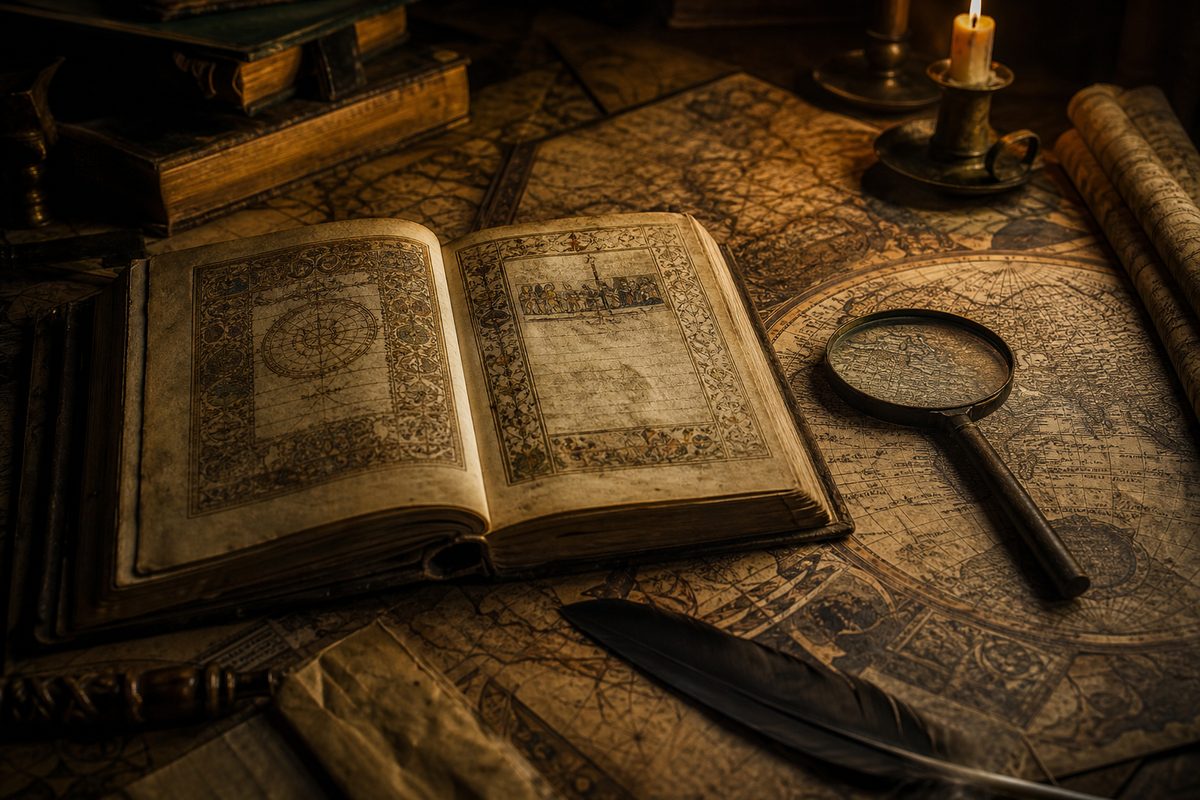
Sources & Further Reading
- Frazer, James George. The Golden Bough (1890–1915) — the foundational comparative treatment of the corn spirit, the last sheaf and European harvest custom.
- Hole, Christina. British Folk Customs (1976) — accessible folk-life survey including crying the neck, corn dollies and harvest-home practices.
- Hutton, Ronald. The Stations of the Sun: A History of the Ritual Year in Britain (1996) — critical reassessment of agrarian and seasonal folklore.
- Folklore (journal of The Folklore Society) — collected regional accounts of last-sheaf naming, the corn maiden and the harvest mare.

Marcus Reyne
Marcus is a historian who writes about the points where folklore and documented history meet. His work for Spirit Tracker traces how myths quietly encode real events, real anxieties and the practical knowledge of the communities that told them.