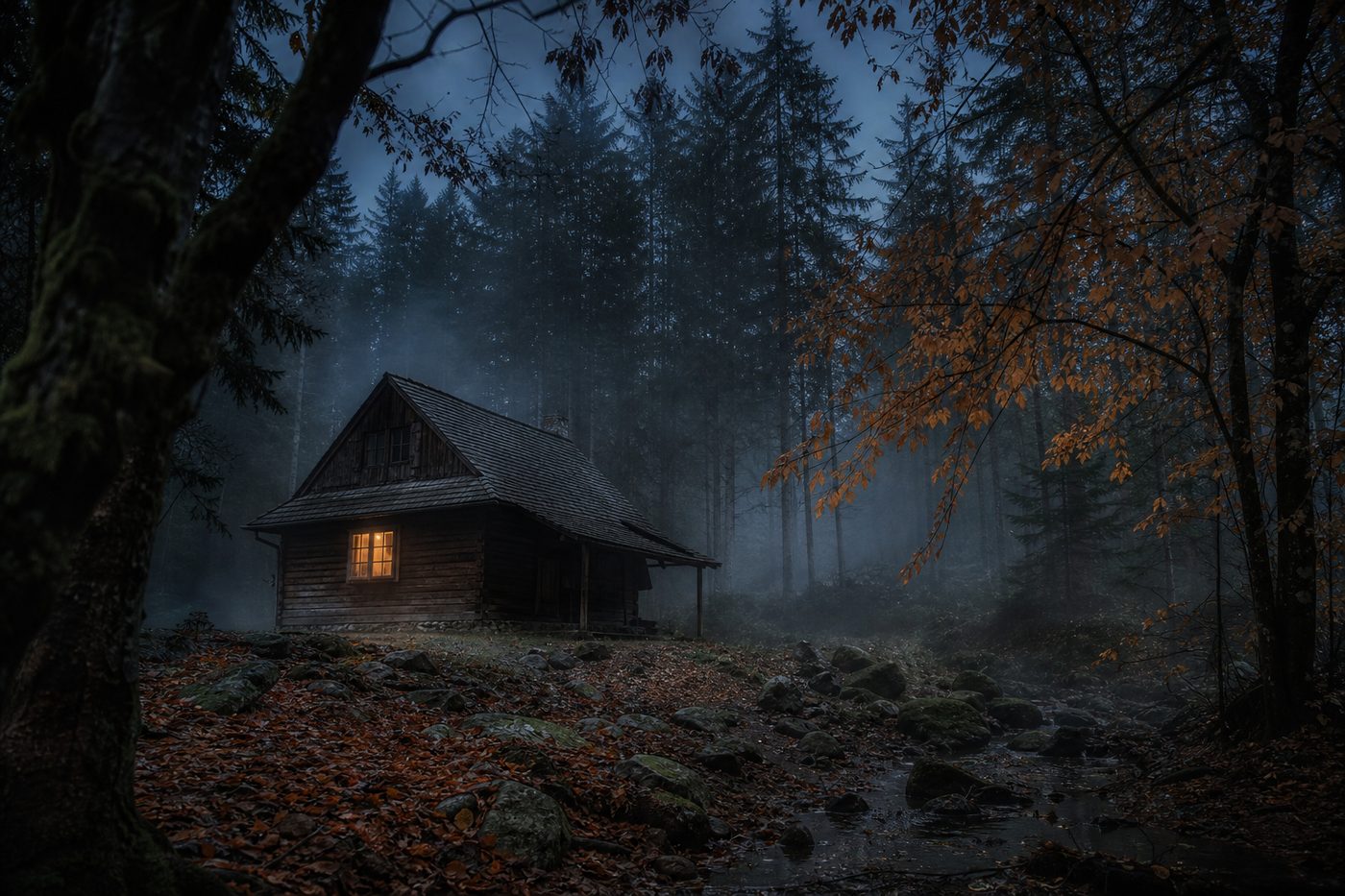
Picture the house. It stands by itself where the cultivated land runs out and the forest begins — a hut, a cottage, a cabin, the precise architecture varies by country. A thread of smoke rises from the chimney. A light burns in the window. And every instinct a folk audience ever possessed tells them the same two things at once: that shelter is waiting inside, and that they must not go in.
That single image recurs with startling persistence across European and Slavic storytelling. The Russian Baba Yaga lives in a hut that stands on chicken legs and spins to face the visitor. The German children Hansel and Gretel stumble on a house built of bread and sugar, only to discover its baker intends to eat them. From Scandinavia to the Alps to the Carpathians, the same figure waits in the same place: a dwelling apart, at the threshold of the wild, occupied by someone who is not quite a neighbour.
Why this house, and why so often? The answer is not that one story travelled and was copied everywhere, though some borrowing certainly happened. It is that separate cultures, facing a shared set of dangers, reached independently for the same picture. The cottage at the forest edge is less a building than a diagram of fear.
The Forest as the Edge of the Map
To understand the house, start with what lay beyond it. For most of European history the forest was not scenery. It was the boundary of the known world — the place where cultivation, law and community gave out. Inside the village you had names, kin, obligation, the protection of being recognised. Step past the last field and you entered a zone with different rules, where outlaws sheltered, predators hunted, and a traveller could simply vanish without anyone ever learning how.
The cottage sits exactly on that line. It is the last structure before the trees and the first structure a lost traveller meets on the way out. That position is the whole point. Folklore loves a threshold, and this is one of the great ones: a doorway between the human order and everything that order was built to keep at bay. To approach the house is to stand with one foot in each world.
Baba Yaga's hut is famously surrounded by a fence of human bones topped with skulls whose eye sockets glow at night. Folklorists read the spinning hut and its grim palisade as a literal model of the boundary between the living and the dead — the house does not merely sit at the edge of the forest, but at the edge of life itself, which is why those who enter it so often emerge transformed.
The Stranger Who Lives Apart
There is a second fear folded into the image, and it is about people rather than places. The person in the cottage lives alone, outside the village, by choice or by exile. In a culture organised entirely around the group — around shared labour, shared faith, shared surveillance — that solitude was deeply suspect. To live apart was to refuse the bargain everyone else had made. And whoever refuses the bargain might owe you nothing.
This is why the cottage's occupant is so often a woman living without a husband, a healer who knows herbs the priest does not approve of, an old person whose usefulness to the community has expired. These were the real figures most likely to be pushed to the margins of a settlement, and the most likely to be feared once they got there. The witch in the woods is, among other things, a portrait of the outsider — the neighbour who became a stranger by ceasing to be like everyone else.
The hut on the edge of the forest is where the social order keeps the people it cannot place. Fear of the witch and pity for the outcast are, in these tales, very nearly the same emotion. — a recurring theme in scholarship on the European household tale
The danger of accepting hospitality from such a stranger sharpens the lesson further. Hansel and Gretel are not punished for being lost; they are punished for eating the house. In a world of recurring scarcity, food offered freely by someone who owed you nothing was not a kindness but a question — what does this cost, and who pays? The gingerbread cottage is a trap precisely because it is too generous. It answers a hungry child's deepest wish, and the wish is the bait.
Why Baba Yaga Refuses to Be a Villain
It would be neat to file all of these houses under the same heading, but the Slavic version resists. Baba Yaga is not the western witch, and the difference matters. She is genuinely frightening — she flies in a mortar, she threatens to cook her visitors, her fence is built of the dead. Yet she is also, repeatedly, a giver of gifts. The hero who approaches her hut correctly, who shows courtesy and completes her tasks, leaves not eaten but rewarded: with a magic horse, with fire, with the knowledge needed to continue the quest.
She functions less like a monster than like a gatekeeper. To cross the threshold of her hut is to enter the realm of the dead and the deeply unknown, and she decides who passes. Those who come with respect and competence are initiated and sent on. Those who come greedy or foolish are destroyed. The same figure is helper and threat, depending entirely on the conduct of the person at her door.
This ambiguity is older and arguably truer than the flattened, purely wicked witch of many western retellings. It preserves something the gingerbread house lost: the sense that the edge of the world is not simply evil, but dangerous and powerful in a way that can be navigated by those who know the rules. The forest does not hate you. It is merely indifferent, and it does not forgive carelessness.
It is tempting to read every forest cottage as a coded record of the witch trials, but the chronology resists it. The image of the dwelling at the wild's edge is far older than the early-modern persecutions and appears in cultures the trials never touched. The witch hunts drew on the folklore; they did not create it. Treating the tales as straightforward history of real persecution flattens a much deeper and stranger inheritance.
What the House Holds Now
The literal fears have mostly drained away. The forest is no longer the edge of the known world; we have mapped, fenced and floodlit nearly all of it, and the stranger living alone at the treeline is now far more likely to be a subject of curiosity than of dread. By every practical measure, the cottage should have lost its charge along with the kelpie and the rest.
It hasn't. The lone house in the woods remains one of the most reliable images in horror film, video games and children's picture books alike, and the reason is that the anxieties it encoded never really left — they only changed address. We still draw a hard line between the safe, lit, social interior and the dark beyond it. We are still uneasy about the person who opts out of the group. We still teach children, in a hundred quieter ways, not to take sweets from strangers or get into unfamiliar cars. The forest moved into the city, but the lesson held its shape.
What endures, in the end, is the threshold itself. The cottage at the forest edge is a way of thinking about every boundary between the known and the unknown, the belonging and the apart, the offered gift and its hidden price. We keep rebuilding that house because we keep arriving at its door — and some part of us still pauses on the step, weighing the light in the window against the dark behind it, deciding whether to knock.
Sources & Further Reading
- Propp, Vladimir. Morphology of the Folktale (1928; English ed. 1968) — structural analysis of the magical helper and the donor figure that illuminates Baba Yaga's role.
- Tatar, Maria. The Hard Facts of the Grimms' Fairy Tales (1987) — on the household tale, hunger and the menace of the forest dwelling.
- Uther, Hans-Jörg. The Types of International Folktales (the Aarne–Thompson–Uther index) — comparative tale-type classification placing the witch's house within international tradition.
- Johns, Andreas. Baba Yaga: The Ambiguous Mother and Witch of the Russian Folktale (2004) — definitive study of the figure's dual nature as helper and threat.

Marcus Reyne
Marcus is a historian who studies the way myths quietly preserve the real anxieties of the societies that told them. He has spent years tracing single images across borders and centuries to find the hard history hiding inside the stories.